

Request a Demo

Whitepaper · CLOUSYS OPERATIONS LIBRARY

The Revenue Leakage Prevention Framework

Separate confirmed billing blockers from estimated exposure.

For CFOs, revenue operations and delivery teams working to reduce preventable delays between completed work and invoicing.
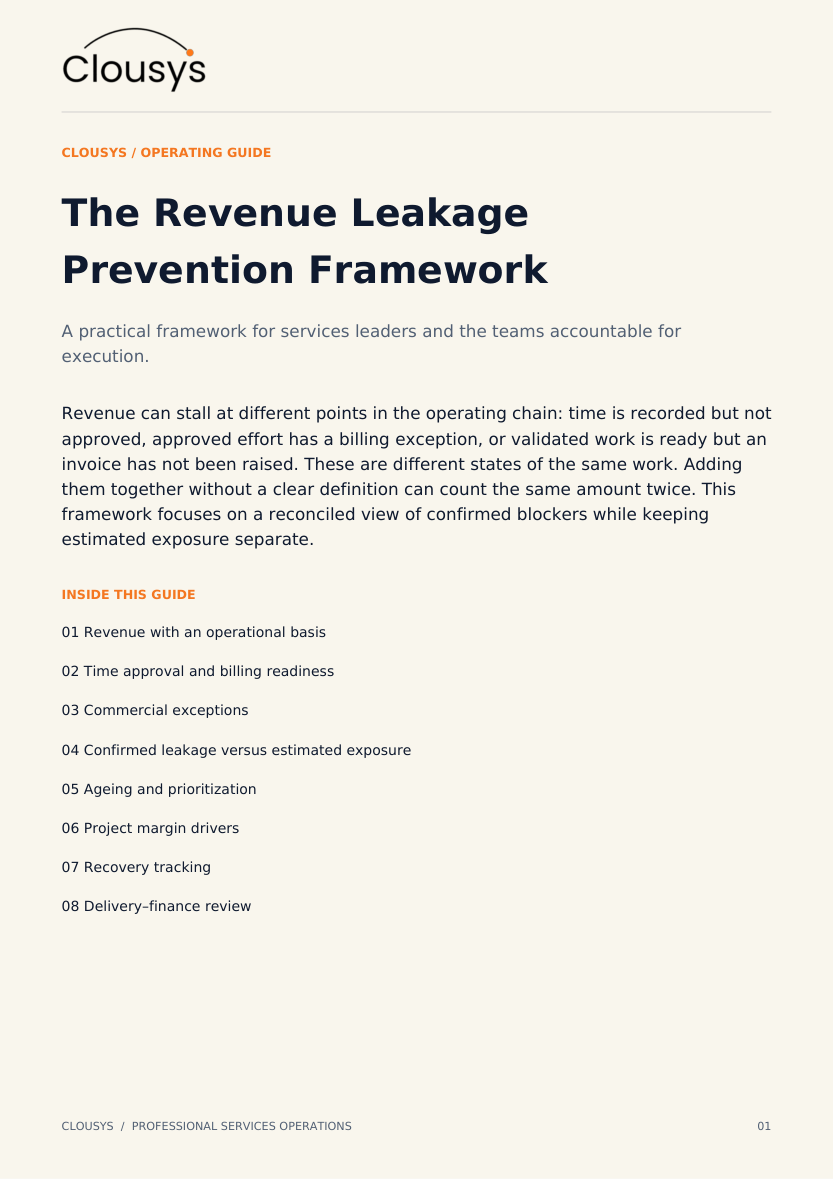
The Revenue Leakage Prevention Framework - document cover

WHY THIS MATTERS

Separate confirmed billing blockers from estimated exposure.

Revenue can stall at different points in the operating chain: time is recorded but not approved, approved effort has a billing exception, or validated work is ready but an invoice has not been raised. These are different states of the same work. Adding them together without a clear definition can count the same amount twice. This framework focuses on a reconciled view of confirmed blockers while keeping estimated exposure separate.

CHAPTER 1

Revenue with an operational basis

Build the forecast from work that can realistically be staffed and delivered. Keep opportunity assumptions, committed work and billing expectations distinguishable. When a date or allocation changes, review the downstream revenue effect instead of updating the finance forecast independently of delivery.

CHAPTER 2

Time approval and billing readiness

Understand where delivered work sits in the approval chain. Submitted time, approved work with an exception and invoice-ready value represent different operational states. Give each state an owner and next action so finance can move work forward without repeatedly requesting the same context.

CHAPTER 3

Commercial exceptions

Review billing exceptions against the engagement’s agreed terms. Rate discrepancies, purchase-order constraints and missing approvals require different resolution paths. Keep the reason and accountable owner visible; a single unbilled total does not explain which decisions will release the value.

CHAPTER 4

Confirmed leakage versus estimated exposure

Keep confirmed blocked revenue separate from modelled exposure. Confirmed amounts should be traceable to transactions; estimates depend on explicit assumptions. Adding both into one total can mislead decision-makers and obscure whether an intervention is resolving an existing blockage or preventing a possible one.

CHAPTER 5

Ageing and prioritization

Review how long value has remained blocked and the cause of the delay. Prioritize aged, material exceptions with the teams able to resolve them. A useful finance view makes the next action visible and lets leaders distinguish an unresolved approval from an invoice already progressing normally.

CHAPTER 6

Project margin drivers

Examine effort, staffing costs, rates and delivery variance alongside the project’s expected revenue. A headline margin percentage is an outcome, not a diagnosis. Trace the variance to operational drivers before deciding whether to change the staffing mix, address scope or revisit the remaining estimate.

CHAPTER 7

Recovery tracking

Track value that was blocked and has moved into invoicing. Define the event counted as recovery so it is not confused with cash collected. Review recovered value alongside new blockages and ageing; a strong month of recovery can otherwise mask recurring upstream problems.

CHAPTER 8

Delivery–finance review

Bring delivery owners and finance into one review of project economics and billing readiness. Agree which exceptions can be resolved now, which need client input and which require leadership decisions. Carry the owner and target date into the next review rather than reopening the same discussion.

TEAM WORKSHOP

Apply the framework to one real engagement.

Review one billing period with delivery and finance together. For every blocked item, record the amount, current state, accountable owner, age and evidence required to move forward. Keep estimated unrecorded effort in a separate view. At the next review, reconcile what moved to invoicing and what remains blocked; do not describe a recovered amount as cash collected unless the payment record supports it.

Agree the review cadence before expanding the scope. Use the same definitions each time and note changes to assumptions. Progress should be visible in the evidence behind the decision, not only in the appearance of a new dashboard.

TAKE THE GUIDE WITH YOU

Use it in your next operating review.

The PDF contains the framework, chapter notes and working-session prompts shown here. Share it with the teams who own the handoffs so everyone can prepare using the same questions.

Your details are not submitted to a mailing list by this download form.

Download the guide (PDF)

A practical example

A finance team sees a large gap between approved work and invoiced value. Some entries await purchase-order resolution, others are ready to bill, and a third group has not been approved. Adding every report together would count some work twice. Start by assigning each transaction to one current state, then determine whether the issue is delay, reduced realization or a genuinely unrecorded estimate.

The measurement behind the decision

Illustrative confirmed blocked value is ₹47 lakh: ₹12 lakh submitted but unapproved, ₹8 lakh approved with a billing exception and ₹27 lakh ready but not invoiced. These mutually exclusive states sum to ₹47 lakh. A separate ₹31 lakh estimate of unrecorded effort or uncovered demand must remain separate. Moving ₹27 lakh to an invoice is operational recovery, not proof of cash collection.

Daily: resolve work that can move now

Sort billing-ready exceptions by value and age, then identify the missing action and owner. Resolve missing approval and missing commercial information through different queues. Keep a record of the original blockage date so moving between states does not reset its age.

Weekly: review recurring causes

Group delayed value by root cause and examine repeat projects or clients. A repeated PO exception may require earlier commercial checks; repeated late time may require manager follow-up. Assign a process correction as well as closing individual transactions.

Monthly: reconcile to finance

Reconcile the operational view to invoicing and revenue recognition policies. Compare opening blocked value, additions, resolutions and closing value. Separate recovery through invoicing from write-offs, corrections and credits, and document period-cutoff rules.

Download the complete field guide

Includes the operating model, worked example, decision tables, implementation cadence and a reusable workshop worksheet.

Download PDF →

THE LATEST FROM CLOUSYS

Ideas for your next operating decision.

View all insights →